Fractional Technology Partner

Everybody runs an AI pilot for six weeks. Nobody's running it six months later.

I build the ones that survive. Measured against a real baseline, with the adoption work built in, and the honest number reported back to you every month — including the months it falls short.

Six-month engagement Two spots, year-round First working win in session one Systems you own, with a runbook
Book a 30-minute call
No pitch. We talk about your business, and I tell you what I actually see.
The pattern

Nothing's wrong with what your team built. It just never travels.

It lives on one laptop

One or two people are genuinely good with AI and quietly building useful things. The output stays on the machine that made it, and emailing files around isn't a distribution strategy.

Decisions don't survive the meeting

Things get decided, then don't get communicated, then get re-decided next month. The agendas live in one-off docs nobody opens twice.

The gap widens, it doesn't close

Every new tool makes your strongest people faster and your least confident people more overwhelmed. Adding seats doesn't fix that.

Nobody measured the before

No baseline means no way to tell whether any of it worked. So the pilot quietly stops and nobody can say what it cost or saved.

And the one nobody warns you about: the ground moves underneath it

The models your system was built against get updated, retired and quietly retuned by the vendor. The configuration that worked in March returns worse answers in September — and nothing errors, nothing alerts, nobody is watching for it. This is the failure mode that has nothing to do with your team's discipline, and it is the reason "we built it and it worked" and "it still works" are different claims. Someone has to be accountable for the second one.

How it works

One arc, five phases, six months.

Refined last June through a five-expert review panel — process and operations, AI architecture, offer strategy, change management, and one reviewer whose only job was to argue against it.

Why me

I've had to keep one of these alive

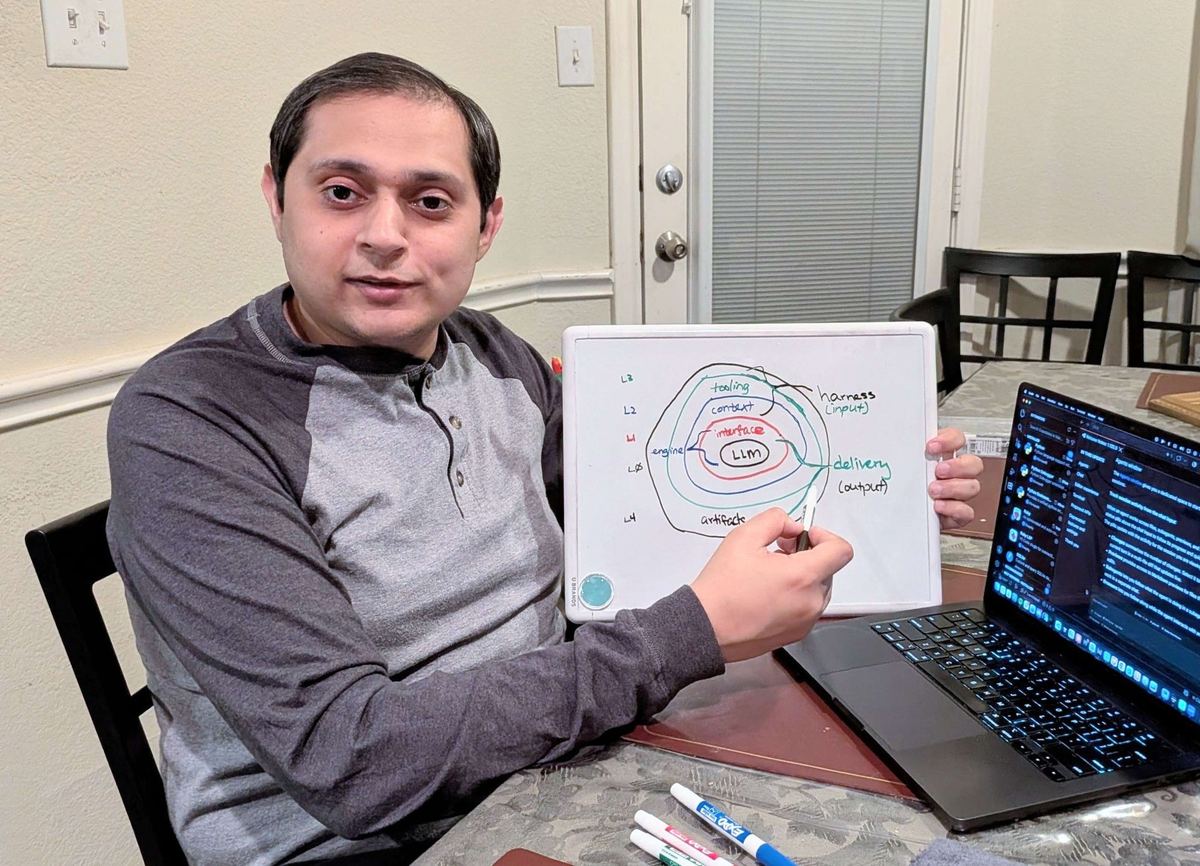
Ahad Amdani at a table holding a whiteboard, diagramming an AI system as concentric layers: an LLM at the centre, then interface, context and tooling, with harness input and delivery output labelled at the edges and artifacts at the base.
Mapping the layers of an AI system. The model sits in the middle and is the smallest part of it — everything that decides whether this works six months from now lives in the rings around it.

Three people's daily job. Now one person, with three hours to spare.

A commercial print business ran orders from their website and Amazon through three people every day: pulling order lists, cleaning them for their commercial printer, reconciling what printed back into tracking. Two verification gates, dozens of formatting rules living in three heads, no SOP anywhere. They'd already bought off-the-shelf tools and a couple of "bespoke" systems that changed nothing.

The mapping took an afternoon and the build took about a week. What took six months was everything around it: coordination, meetings, and the other work already in flight. That gap is the thing I'm actually hired to remove. It took the work off two people entirely and gave the third back three-plus hours a day — and that third person alone is worth roughly $650 a month at a modest loaded rate, before you count the two who no longer touch it at all. The engagement returned a multiple of itself inside the first quarter.

Who this is for

This fits if

  • You have a team, and AI capability is concentrated in one or two of them
  • You've already spent money on AI and can't point at what it returned
  • You need senior technical judgment but not another full-time executive
  • You'd rather own the systems than rent them
Who it isn't

This isn't for you if

  • You want someone to build one thing and leave
  • You're looking for the cheapest hands available
  • Nobody internally has time to adopt anything new
  • You want the pilot, not the part where it sticks
What changes

Old spend, new spend — on my own business

I built this for myself before I sold it to anyone. This is my operation, not a client's, so you can see the shape of the change rather than take a case study on faith.

The workBeforeNow
Daily content — two LinkedIn posts, two Substack notes Written by hand, when there was time. Often there wasn't, so nothing went out. Drafted overnight. About five minutes each morning to review and approve.
Weekly newsletter Most of a day, on the weeks it happened at all. Drafted and rendered ahead. Publishes Wednesdays whether or not I'm free.
Meetings and follow-ups Notes taken if there was time, then never opened again. Every call transcribed, decisions extracted, tasks updated, and anything needing me surfaced the next morning.
Research and reference Bookmarks nobody reopens. Captured, indexed and semantically searchable — 700+ documents I can actually ask questions of.
When the AI provider goes down Work stops until it comes back. A fallback picked up the missed run in about seven minutes, with publishing rights deliberately withheld from the backup.

The point isn't the hours. It's that none of it depends on me having a good week — which is the only reason any of it is still running six months later.

Investment

Priced so the arithmetic isn't close.

Two spots open
Six-month engagements

The price is set before we ever talk. What we work out on the call is what the work is worth to your business: what you spend on this now, against what it becomes. If that math doesn't clear the fee, I'll say so on the call instead of selling you anyway. Two ways to pay: the six months up front, or split across the months, which costs 10% more than paying up front.

Why six months and not a project. The audit and the build are the easy halves. Whether your team is still using any of it in month five is what decides whether this was worth the money — and that isn't something you can buy in a sprint.

What I hold myself to. I'm not interested in an engagement where you're doing the arithmetic at the end and it's close. We capture a real baseline in the first two weeks and I report against it honestly, including where it fell short. The engagement should return multiples of what it cost, and you should be able to see the number rather than take my word for it.

Two spots is a real constraint, not a scarcity tactic. Beyond two, the depth I'm describing isn't something I could honestly deliver.

Terms

Plainly

Start with a conversation

Thirty minutes. We talk through where your business actually is, what's technically stuck or exposed, and whether this is even the right shape of help. If it isn't, I'll tell you.

Book a 30-minute call
Same calendar I use for every strategy call. Pick a slot that suits you.
Book a 30-minute call